

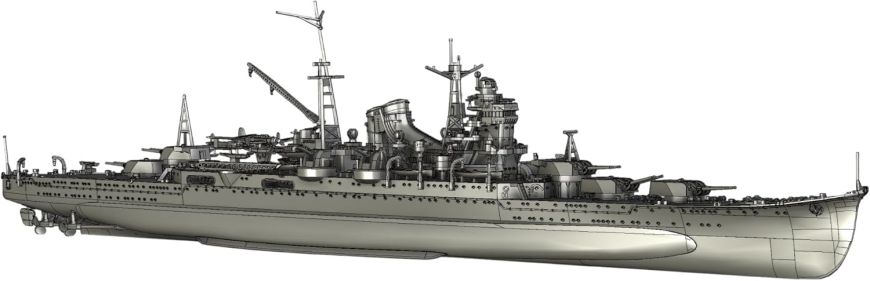
Fujimi1/700 IJN Series No.52 Japanese cruiser Mikuma (1942)
Special Price
¥3,920
Regular Price
¥4,900
Out of stock
SKU
FUJ52494
 You will earn 10 Points for writing a review this product. You will earn 117 Points for purchasing this product.
The Mikuma as she appeared in 1941?1942, following the main gun refit and conversion to a heavy cruiser, is now available as a full-hull model kit using dedicated molds. (Basic Specifications) ・This is an unpainted kit requiring assembly and painting. ・The scale is 1/700, and the model features a full-hull design, including the ship’s bottom. ・The product is composed of molds from the existing “Special Series” and newly added molds ・The section below the waterline is based on the 2025 design, while the above-water section is based on the 2019 design (Product Specifications) ・The product is modeled after the second ship of the Mogami class, “Mikuma,” from the start of the war in 1941 through the Battle of Midway in 1942 →Reproduces the hull cross-section shape, which differs from that of the 3rd and 4th ships (Suzutani/Kumano), as well as the presence or absence of air intake trunks and differences in funnel thickness due to the greater number of boiler rooms →Reproduces the appearance with unblocked portholes prior to post-battle modifications using dedicated parts →Reproduces the aft mast, which distinguishes it from the lead ship, Mogami, using dedicated parts ●Hull ・The hull parts for the early-production Mogami-class ships “Mogami” and “Mikuma,” which feature a non-sloped hull side (at the middle deck level), are custom-made. →These are custom-molded parts with a hull side cross-section shape different from that of the later-production ships Suzutani and Kumano. → The high-angle gun deck is 1.0 mm wider (in scale) than that of Suzuyama and Kumano, and is constructed using dedicated parts → The external wiring is reproduced using parts molded as a single unit with the hull and included photo-etched parts → This represents a hull shape distinct from that of the Mogami, Suzuyama, and Kumano ・The port windows are unblocked, and their numerous arrangement along the hull is reproduced with delicate engraving. →These parts are produced using a dedicated mold to differentiate them from the blocked port windows seen on the Mogami, Suzuyama, and Kumano after 1943. ・The parts are divided into left and right sections, with the structure split at the waterline between the freeboard and the hull bottom. ● Bridge ・Transparent parts for the bridge windows allow for a more realistic finish ・Features bridge structure parts exclusive to the Mogami and Mikuma, which lack boiler room air intakes on the sides of the bridge ・The floors of the Anti-Aircraft Command Post and the Compass Bridge feature finely engraved grating patterns ・Includes a binocular part for the Anti-Aircraft Command Post that enhances the sense of precision simply by attaching it ・The machine gun mount in front of the bridge features dedicated parts for a 13mm twin machine gun ・The forward mast is reproduced with a simple tripod structure using just two parts ●Fittings/Central Section ・The boiler room air intake trunk, installed only on early-production versions of the Mogami and Mikuma, is reproduced with dedicated parts ・The early-production Mikuma carried 12 boilers?more than the late-production models?so a thick funnel characteristic of this design is included → Shaped using a dedicated part distinct from the slender front-side flue type found on Suzuyama and Kumano ・The funnel cap is molded in a “removed” state ・The steam discharge pipe is designed as a separate part to enhance realism ・The structure behind the funnel (below the searchlight) uses parts exclusive to the Mogami and Mikuma. ・The linoleum deck features a dedicated part, as the placement of ventilation pipes and equipment differs from that of the Suzuyama and Kumano. ・The 12.7 cm twin anti-aircraft gun mount uses parts exclusive to the Mogami and Mikuma; specifically, the early-production ship version lacks protrusions on the underside of the mount. ・The position of the torpedo tubes can be adjusted to any orientation → Allows for reproduction of both the standard position aligned with the ship’s centerline and the rotated firing position ・The shelter housing the torpedo tubes, including the spare torpedo storage compartment, has been modeled in 3D based on official drawings ・The floor surface features a strip pattern reproduced with delicate, high-quality engraving ・The catapult (Kure Type 2 Model 5) features realistic side and top surfaces achieved through slide molding ・The central section of the flight deck consists of dedicated parts that lack the air intakes found on later-model ships ●Outfitting / Stern ・The aft mast is a Mikuma-specific part that reproduces the ship’s distinctive crossbeam height ・The hoist crane reproduces the shape differences from later-production ships; it features finely detailed engravings and a distinctive, slightly hollowed-out shape ・The side of the aft bridge features a custom part that reproduces the air intake vents, which are arranged differently from those on later-production ships ・The antenna mast mounted on the 3rd and 4th main gun turret roofs is a custom part that reproduces the unique shape specific to each ship ●Fittings/Armament ・The main gun barrel has a fixed elevation angle, but the turret can still rotate after assembly ・The 25mm twin machine gun set includes precision parts with separate barrels and mounts →The molded colors are Navy Blue for the base and Gunmetal for the barrels →For painting, this design makes it easy to apply separate colors by painting each part individually and then assembling and gluing them together while still on the sprue ●Hull Bottom ・The hull bottom parts are constructed as a single, integrated left-right unit ・The side bulges below the waterline are separate parts, while the bulges on the hull above the waterline are rendered as an integral part of the hull ・The shape of the shaft brackets and the curved surface of the eddy plates are realistically rendered ・The thickness of the rudder mounting is reproduced, and the surface of the twin-blade rudder features engravings for a three-dimensional design ・Water intake and discharge ports are engraved on the hull bottom ・The bilge keel is integrated with the bulges, and the bulges reproduce the enlarged external shape adopted after performance improvements ●Aircraft ・Includes 1 Type 0 (three-seat) Seaplane Reconnaissance Aircraft and 2 Type 95 Seaplane Reconnaissance Aircraft → The Type 95 Seaplane Reconnaissance Aircraft features separate parts for the upper wing and three floats, resulting in a highly detailed design → The Zero-type Seaplane Reconnaissance Aircraft features a structure with separate parts for the main float and propeller ・Molded in gray to improve ease of assembly (and prevent damage during gate cutting) ● Decals ・Two types of decals are included, totaling two sheets ・One sheet contains markings such as the naval ensign, national flag, and the Hinomaru for carrier-based aircraft →Three sizes of the naval ensign are provided. The dimensions are based on the actual 10-ken, 6-ken, and 3-ken sizes scaled down to 1/700 →Includes the Hinomaru for carrier-based aircraft and friendly identification bands (yellow bands); the Hinomaru also includes versions without the white border used in the later stages of the war ・1 sheet of decals featuring the stern ship name, white lines for the aft mast, and waterline marks → The stern ship name is available in two versions: gold and solid navy blue [Contents] 30 sprues, 2 assembly manuals, 2 decal sheets Completed size: approx. 287 x 34 x 60 mm (Length x Width x Height) [Design/Mold Development Dates] Main body: Manufactured in 2019; 2-piece machine gun parts: Manufactured in 2018; Ship bottom: Manufactured in 2025 Please note that colors may appear different from the actual product due to monitor settings and image resolution.
| Package Depth (mm) | 410 |
|---|---|
| Package Height (mm) | 150 |
| Package Width (mm) | 70 |
Write Your Own Review